> For the complete documentation index, see [llms.txt](https://chndth.gitbook.io/ionic-taxi-app-setup-doc/llms.txt). Markdown versions of documentation pages are available by appending `.md` to page URLs; this page is available as [Markdown](https://chndth.gitbook.io/ionic-taxi-app-setup-doc/initial-version/android-setup/ios-setup.md).
# Ios Setup
## Capacitor iOS Documentation
Capacitor features a native iOS runtime that enables developers to communicate between JavaScript and Native Swift or Objective-C code.
Capacitor iOS apps are configured and managed with Xcode and [CocoaPods](https://cocoapods.org/).
### iOS Support[](https://capacitorjs.com/docs/ios#ios-support)
iOS 13+ is supported. Xcode 13+ is required (see [Environment Setup](https://capacitorjs.com/docs/getting-started/environment-setup#ios-development)). Capacitor uses [WKWebView](https://developer.apple.com/documentation/webkit/wkwebview), not the deprecated [UIWebView](https://developer.apple.com/documentation/uikit/uiwebview).
### Adding the iOS Platform[](https://capacitorjs.com/docs/ios#adding-the-ios-platform)
First, install the `@capacitor/ios` package.
```
npm install @capacitor/ios
```
Copy
Then, add the iOS platform.
```
npx cap add ios
```
Copy
### Opening the iOS Project[](https://capacitorjs.com/docs/ios#opening-the-ios-project)
To open the project in Xcode, run:
```
npx cap open ios
```
Copy
Alternatively, you can open Xcode manually by running:
```
open ios/App/App.xcworkspace
```
Copy
### Running Your App[](https://capacitorjs.com/docs/ios#running-your-app)
You can either run your app on the command-line or with Xcode.
#### Running on the Command-Line[](https://capacitorjs.com/docs/ios#running-on-the-command-line)
To run the project on a device or simulator, run:
```
npx cap run ios
```
Copy
The command will prompt you to select a target. [Learn more about `run`](https://capacitorjs.com/docs/cli/commands/run).
#### Running in Xcode[](https://capacitorjs.com/docs/ios#running-in-xcode)
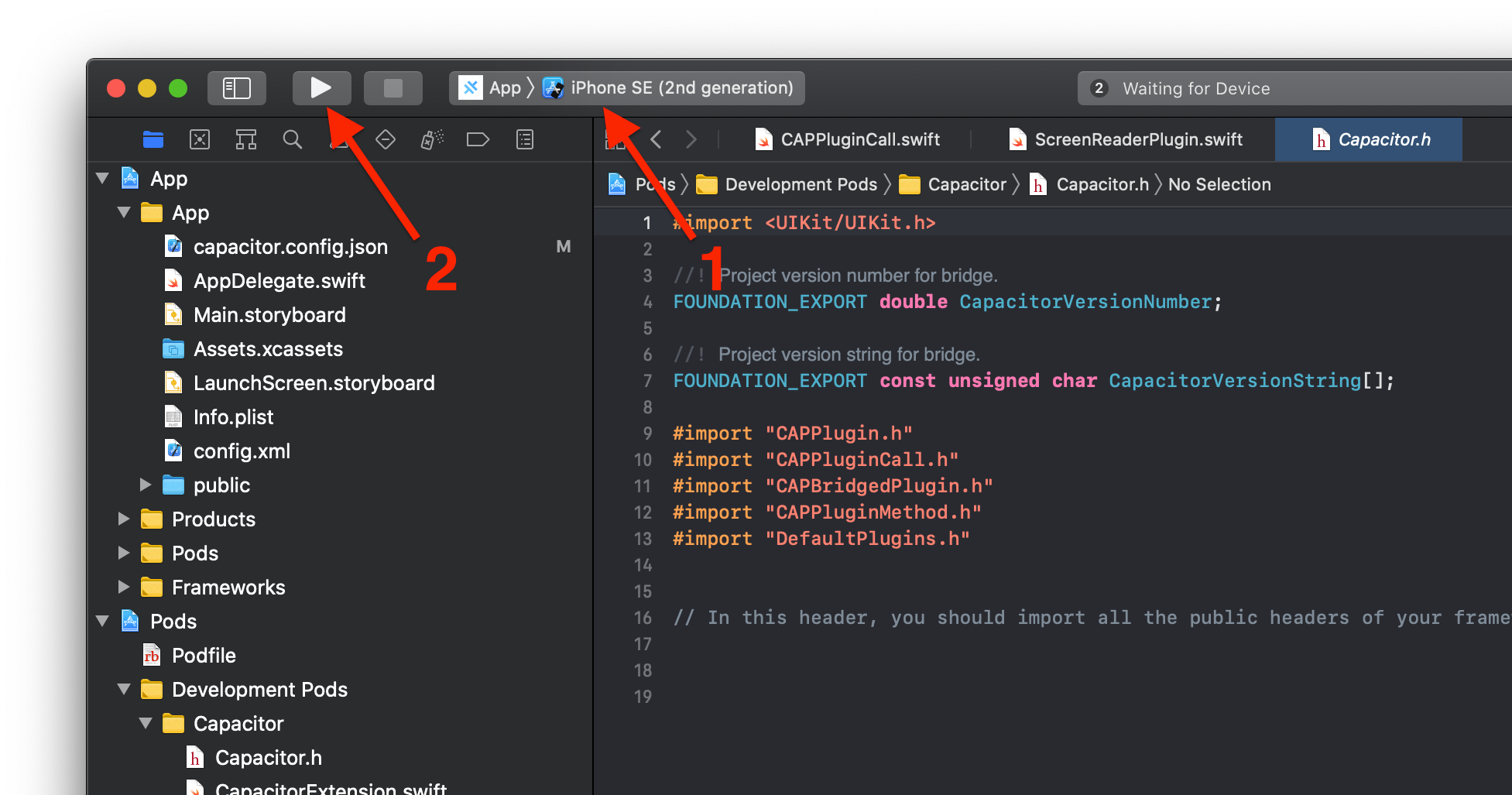
In Xcode, first select the device or simulator and then click the play button to run your app.
### Troubleshooting[](https://capacitorjs.com/docs/ios#troubleshooting)
If you encountered any issues while getting started, you can consult the [iOS Troubleshooting Guide](https://capacitorjs.com/docs/ios/troubleshooting). Feel free to [open a discussion](https://github.com/ionic-team/capacitor/discussions/) if you need help.
### Next steps[](https://capacitorjs.com/docs/ios#next-steps)
You are now ready to continue developing and building your app. Use the various APIs available, Capacitor or Cordova plugins, or custom native code to build out the rest of your app.
### Further Reading[](https://capacitorjs.com/docs/ios#further-reading)
Follow these guides for more information on each topic: